
Let’s be honest: cleaning a pool is rarely the reason you bought one. It’s a chore—scrubbing walls, chasing debris, vacuuming the floor, and constantly checking the filter. It eats up your weekends and often leaves you wondering if there’s a better way to get the job done. That’s where smart technology is stepping in. An AI robotic pool cleaner promises to take over the dirty work, but does it actually deliver a meaningful upgrade to your routine, or is it just a gimmick with a high price tag? In this guide, we’ll break down exactly what these devices do, how they differ from standard robotics, and whether the investment makes sense for your specific pool setup.
Key Takeaways
- AI pool cleaners use sensors and cameras to map your pool, allowing for systematic cleaning patterns rather than random bouncing, which saves time and battery life.
- They excel at obstacle avoidance and wall climbing, making them significantly more effective at navigating complex pool shapes and features like steps and sun shelves.
- While more expensive, an AI model offers higher automation and less manual intervention, which is ideal for busy pool owners who prefer a “set it and forget it” approach.
- To gain the full benefit, proper setup and regular maintenance of the cleaner itself are essential; these robots are not entirely maintenance-free.
What Makes a Pool Cleaner “AI-Powered”?
To understand whether an AI cleaner improves your routine, you first need to know what separates it from a standard robotic cleaner. A traditional robot relies on a random or semi-random navigation algorithm. It bumps into a wall, turns, and goes in another direction until it eventually covers the majority of the pool—statistically speaking. This process works, but it is inefficient. It often misses spots on the first pass and uses more battery life because it covers the same areas multiple times.
An AI robotic pool cleaner fundamentally changes this approach. Instead of guessing, it uses sensor fusion—typically a combination of gyroscopes, accelerometers, and optical or lidar-based sensors—to create a mental map of your pool. It understands the shape, identifies the waterline, and recognizes obstacles like drains and ladders. This allows it to plan a systematic grid-like route. It cleans in straight, parallel lines, ensuring complete coverage without redundant passes. The result is a more efficient cycle, cleaner water, and a filter basket that collects more debris in a single run.
The Role of Vision and Mapping
The most advanced units go a step further by using a camera with visual positioning. This is very similar to how a robot vacuum inside your home works. The camera detects features in the pool, such as tiles or specific wall contours, to track its position in real-time. This is crucial for pool environments where water current and buoyancy cables might cause drift. By continuously correcting its course, the robot can precisely navigate a complicated pool floor and achieve full-wall coverage up to the waterline, verifying it has actually cleaned the surface rather than simply assuming it did.
How Does an AI Cleaner Transform Your Daily Routine?
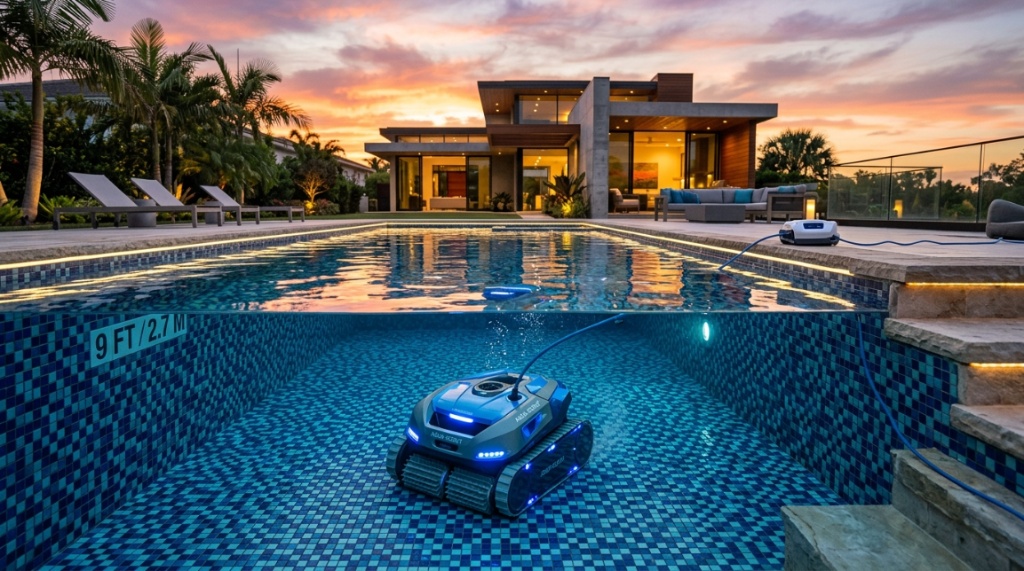
The real question isn’t just about chips and cameras; it’s about what that technology does for your schedule. If you have a standard suction-side cleaner or a basic robotic model, you likely have to play an active role in the process. You might need to pull the cleaner out before swimming, re-position it if it gets stuck on a main drain, or run it twice because you spot a missed patch of leaves near the steps.
Investing in an AI robotic pool cleaner shifts the balance toward a “hands-off” experience. Because the unit understands the layout, it is far less likely to get stuck on obstacles. If it does encounter a ladder, it uses its mapping to navigate around it rather than tipping over or spinning its wheels. Furthermore, many AI models offer smart return-to-base functionality. When the battery gets low or the cleaning cycle is complete, the robot calculates the most direct path back to the edge, so you don’t have to fish it out with a pole. This saves you roughly 10 to 15 minutes per cleaning session on average, just in supervision time.
Battery Management and Cleaning Efficiency
Efficiency is not just about time; it’s about energy. Standard cordless robots often run out of battery just as they reach the far end of a large pool, leaving you with a half-finished job. AI systems actively manage power consumption. They adjust scrubbing intensity and motor speed based on the debris load and the surface type. For example, they might use less power gliding across a smooth fiberglass floor but ramp up suction when sensors detect gritty sand or heavy dirt.
This intelligent power distribution means a single charge is often enough to clean a larger pool or perform a more thorough job on a smaller one. You benefit from fewer recharges and a cleaner pool floor, without having to manually restart the unit to finish the job.
Is the Higher Price Tag Actually Justified?
It is common to scroll through the options and wonder if paying double the price of a standard model is really necessary. The justification comes down to longevity and structural finish. Pools with vinyl liners, fiberglass surfaces, and intricate tile work can be accidentally damaged by cleaners that mindlessly bang into walls. An AI robot uses collision detection in a smarter way. It slows down before touching the wall and uses the bumper to guide itself along the perimeter without scraping the surface.
For pools with unique architecture—such as free-form designs, grottos, or large sun shelves—the AI’s adaptive navigation is highly beneficial. A standard robot might miss the shallow shelf entirely if its random pattern doesn’t take it there, whereas an AI unit creates a specific zone for that area. If you have a large, unusually shaped, or feature-rich pool, the AI premium is often worth the cost because it prevents the frustration of buying a “smart” device that still needs your help to get every corner.
Comparing AI Robots to Traditional Pool Cleaners
To decide effectively, you must weigh the options on the market. Here is a quick comparison highlighting the differences between pressure-side, standard robotic, and AI robotic cleaners.
| Feature | Pressure-Side Cleaner | Standard Robotic Cleaner | AI Robotic Cleaner |
|---|---|---|---|
| Navigation | Random water flow | Random / Pattern-based | Systematic mapping |
| Filtering | Uses pool pump/filter | Independent internal filter | Independent internal filter |
| Wall Climbing | Limited to floor | Good (all surfaces) | Excellent (tracks ascent with sensors) |
| User Intervention | High (hose tangling) | Medium (may get stuck) | Low (obstacle avoidance) |
| Energy Efficiency | Costly (pump usage) | High (low voltage) | Very High (optimized battery use) |
As the table shows, the upgrade from a standard robot to an AI robot is mostly about intelligence and autonomy rather than raw suction power. If you are also dealing with stubborn bathroom maintenance issues like White Marks on Black Shower Tray, check out our expert guide for effective removal solutions.
Practical Steps to Maximize Your AI Cleaner
Buying the technology is only half the battle. To truly improve your cleaning routine, you need to set yourself up for success. Here are actionable steps to ensure your AI robot performs at its best.
1. Optimize the Docking Station
Place the charging dock in a location that allows the robot to climb out easily. If the water level is too low or too high, the robot might struggle to reach the dock. Ensure the cable is untangled and that the dock is on a flat, stable surface at the pool’s edge.
2. Schedule Frequent, Short Cleanings
Relying on your robot to do a massive 3-hour deep clean once a week is less effective than running it for 1 hour every other day. AI mapping is most efficient when it is maintaining a baseline of cleanliness. This prevents debris from accumulating and reduces the load on your pool’s main filtration system.
3. Clean the Robot’s Filter After Heavy Use
Even the smartest robot cannot compensate for a clogged filter. If you have had a storm or a heavy party, check the basket immediately after the cycle. A clean filter ensures constant water flow, which is essential for the navigation sensors to operate accurately and for the robot to climb walls effectively.
4. Use the App for Spot Cleaning
Most AI models connect to a smartphone app. Instead of manually skimming the surface of the pool after a windy day, use the app’s “floor-only” or “waterline” mode. This saves battery and targets the specific problem area (the bottom) rather than wasting time cleaning walls that are already spotless.
Frequently Asked Questions
Can an AI robot damage my pool’s surface?
No, not typically. In fact, AI cleaners are often safer than older models. Because they use sensors to detect walls and obstacles, they reduce the impact force against the pool wall. They use softer brushes and controlled movements, which are gentler on delicate surfaces like vinyl liners and tiles compared to cleaners that rely on random bouncing.
How long does an AI robotic pool cleaner last?
Most quality robotic cleaners have a lifespan of about 3 to 5 years with regular use. The brushes and filters are wear items that may need replacement every 1 to 2 years. The internal battery is typically the first major component to degrade, but the AI navigation system can help extend the life of the motor by preventing it from running dry or operating inefficiently against a clogged intake.
Does an AI cleaner eliminate the need to brush the walls?
It greatly reduces the need. However, the waterline—where the water meets the tile—can accumulate oil and calcium deposits that are too stubborn for the scrubbers on most robots to remove. While the robot will reach and scrub the waterline, you may still need to manually wipe the tile with a sponge once a month to remove scum lines.
Will the robot work if my pool is not connected to a separate pump?
Yes, this is one of the primary advantages of robotic cleaners. are completely self-contained. operate on low-voltage electricity from their own power supply and have an internal pump and filter system. do not rely on your pool’s main circulation pump, which helps you save money on your energy bill.
Conclusion
Switching to an AI robotic pool cleaner is less about buying a gadget and more about reclaiming your time. The technology removes the need for constant supervision, solves the issue of “missed spots” through systematic mapping, and ultimately ensures your pool remains ready for swimming with less effort on your part. While the upfront cost is higher than traditional options, the value is clear if you want consistency, efficiency, and a hands-free experience. For pool owners dealing with complex layouts or busy schedules, an AI cleaner transitions the chore from an active task to a passive background function, allowing you to simply enjoy your backyard oasis rather than work for it.